Maria Firman
Recently, the regional literary scene has been buzzing with exciting visual projects. A new comics anthology, Delay, brings together 11 pieces of short-form graphic fiction from various Southeast Asian artists across Singapore, Malaysia, Indonesia, and the Philippines. Among the featured works is The Other World by Cathlyn Vania, an accomplished writer, illustrator, and comic artist. We also saw the release of Elang Jawa, a comic by Fajar Nugros and illustrator Apri Kusbiantoro that explores a fictional narrative surrounding the border dispute between the Yogyakarta and Surakarta Sultanates (which has also been published in German and Dutch). Moreover, Debra H. Yatim’s short story Joseviolis—a winner of the 25th Harian Kompas anniversary short story competition in 1990—has returned with a fresh face, launched by publisher Sebermula in a graphic literature format.
The relationship between text and image has a long history. From William Blake’s illuminated books where poetry and engraving intertwine, to modern graphic storytelling, combining words and art always demands a unique framework for understanding. These latest developments at the intersection of literature and art prompted us to reflect on how we document such works in the IDWRITERS database accurately and effectively.
Moving forward, here is the updated categorization we will be applying to our catalog:
Sequential Visual Narratives
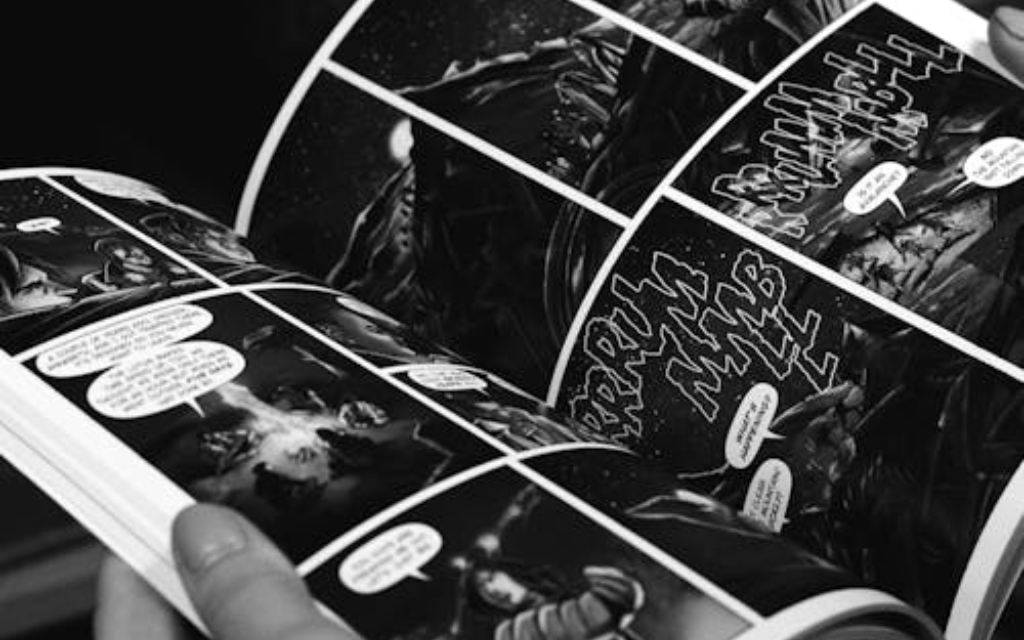
Narratives in which meaning is constructed primarily through sequential images arranged in deliberate progression. The reader interprets time, movement, causality, and emotion through visual continuity across panels, pages, or visual units.
The core mechanism is sequence.
Text may appear (dialogue, captions, narration), but the structural engine of storytelling is the ordered visual progression.
1 Comics
A broad category for works using sequential art as the primary narrative system. Can appear as serialized issues, strips, anthologies, or collected editions. Comics describe the medium, not the length.
Examples:
- Elang Jawa: Bandit Pasar Setan https://idwriters.com/books/elang-jawa/
- DELAY, a Comics Anthology https://idwriters.com/books/delay/
2 Graphic Novel
A long-form, self-contained narrative within the comics medium. Structured as a complete book-length work, often more complex in theme or structure, and may be originally published as a volume or collected from serialized issues. Graphic novels describe format and narrative scope, not artistic style.
Examples:
- Hujan Bulan Juni https://idwriters.com/books/hujan-bulan-juni/
- Seri Buku Toleransi: Prasangka Moka https://idwriters.com/books/prasangka-moka/
Integrated Visual–Text Narratives
Narratives in which images and text are interdependent and jointly construct meaning, but do not rely on panel-based sequential art. The core mechanism is interdependence, not sequence. Remove either the images or the text and the narrative becomes incomplete, diminished, or structurally broken.
3 Picture Book
A specific format where image and text function as co-equal narrative agents. Typically shorter in length, illustrations drive emotional tone and narrative inference, and text is concise and strategically placed. While most commonly associated with children, the format itself is not age-restricted.
Examples:
- Monkey’s Sweet Surprise https://idwriters.com/books/monkeys-sweet-surprise/
- Tantangan Besarku https://idwriters.com/books/tantangan-besarku/
Illustrated Prose
Prose-based works in which the narrative is fully contained within the text, and illustrations serve a supplementary, decorative, interpretive, or clarifying function. The core mechanism is textual primacy. If the images are removed, the narrative remains intact.
4 Illustrated Book
A general category for prose works enhanced with images. Can target children, YA, or adult; includes fiction and nonfiction, illustrations may appear per chapter or in sections, and visuals are supportive rather than structural.
Examples:
- The Kalimatan Dolphin and Other Indonesian Tales https://idwriters.com/books/kalimantan-dolphin/
- Braga at Paris van Java https://idwriters.com/books/braga-at-paris-van-java/

To put it simply, our classification breaks down like this
| Category | Narrative Engine | Dependency Level | Structural Basis |
| Sequential Visual Narratives, ie. Comics | Image sequence | High visual dependency | Panels / ordered frames |
| Integrated Visual–Text Narratives, ie. Picture Book | Image-text interdependence | Mutual dependency | Page-based composition |
| Illustrated Prose, ie. Illustrated Book | Text | Low visual dependency | Paragraph-based prose |
What are your thoughts on this new framework? Does this categorization accurately capture the diverse, beautifully illustrated works you love to read?
Let us know in the comments, or drop a title you think might challenge these boundaries.
Apr 05, 2026 (Last modified: Apr 05, 2026)In this article Braga at Paris Van Java DELAY Elang Jawa Hujan Bulan Juni: Novel Monkey’s Sweet Surprise Seri Buku Toleransi: Prasangka Moka Tantangan Besarku The Kalimantan Dolphin and Other Indonesian Tales Alanda Kariza Cathlyn Vania Fajar Nugros Foggy FF Murti Bunanta Patricia Tanumihardja Sapardi Djoko Damono Sekar Sosronegoro
Latest Story
Sep 08, 2026
Aug 22, 2026
Aug 19, 2026
Aug 14, 2026
Call for Submissions
We welcome submissions across multiple genres including poetry, fiction, book reviews, cultural essays, and literary-focused features and opinion pieces. Please note that we only accept previously unpublished work. Accepted drafts may be edited in collaboration with our team before publication.
We’re excited to hear from writers at all stages of their craft. You can find our full submission guidelines here


Leave a Reply