IDW
Don’t think of bad luck, everything will be fine.
Mei whispered the sentence three times as she shook her head, also three times, to cast away the bad thought that had just visited her mind.
She then found a tree trunk and knocked on wood. Three times.
Three times repeating the sentence. Three times head shaking. Three knocks on anything made of wood.
The sequence of threes was a part of Mei’s Good Luck Formula which she had to execute just now because a bad thought had just visited her: her Mama, who had stayed home from work today because she was feeling sick, maybe had a heart attack or took a bad, bad tumble in the bathroom. All would have incapacitated her from calling for help. Mama did not answer Mei’s calls. But Mei was serene now because she was certain that her Good Luck Formula had saved Mama from an evil happening, whatever it was. Mama is fine, I know it, she whispered to herself.
So the complete Mei’s Good Luck Formula to prevent bad luck was this:
- Three times repeating the sentence: Don’t think of bad luck, everything will be fine.
- Three times head shaking.
- Three knocks on wood.
- Do #1, #2, #3 when a bad thought enters the mind to prevent it from coming true.
- Always go with number three (three times checking if the door is locked or the stove is turned off, three cookies, etc).
- Avoid number four! Four (four = 四 = sì) sounds similar to “death” (death = 死 = sǐ).
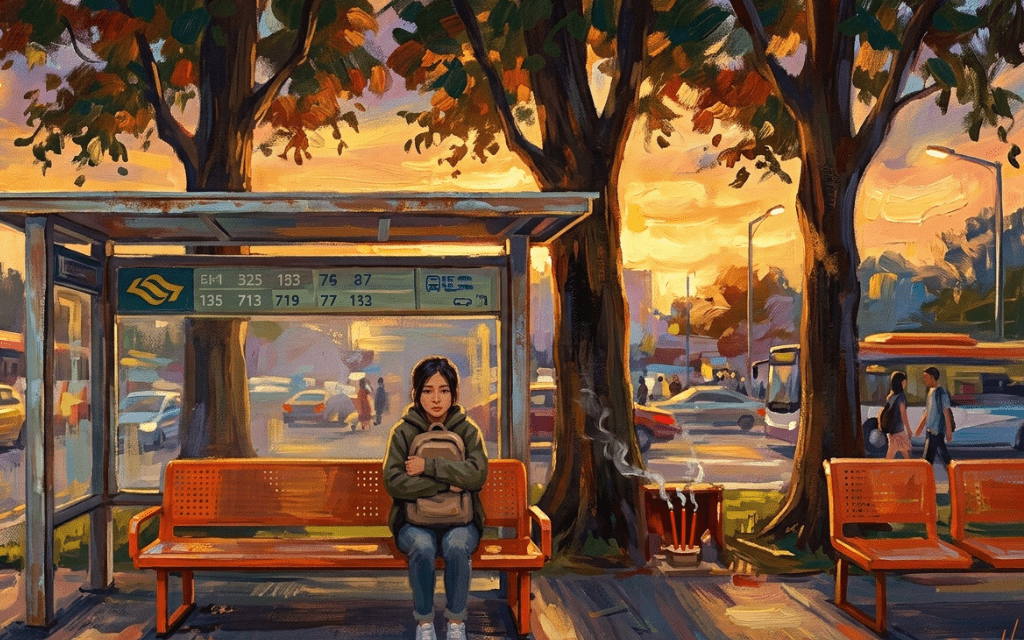
Mei’s eyes scanned the busy street in front of her campus as orange-yellow dusk fell. She was waiting for her bus to go home. Pressing her backpack against her chest, she sat on the cold orange bench of the bus stop. There were three benches in this bus stop. Behind the bus stop, three beech trees stood like three giants guarding the place. All these threes made Mei believe that this was her lucky bus stop, the reason she would walk 10 minutes longer to this stop instead of taking the bus at the stop closer to her classroom (that stop had four benches, number four was bad luck).
The Good Luck Formula had successfully prevented bad luck in Mei’s life since last year.
Last year was so bad that it became the main reason why Mei resorted to the strict regimen of the Good Luck Formula.
Last year was the year her soul cracked.
She lost Papa. Grandma. Māo-māo, her cat.
With each death, a piece of her soul cracked, and the crack grew deep and spread like a shattered mirror with each passing day.
She was living in fear of more bad luck coming her way (she knew she could not handle more sorrow), so when one morning she saw Mama pray to the Goddess of Mercy, Guanyin (觀音, Guānyīn), using three joss sticks so the Goddess would bless them with a happy home, something clicked in her cracked soul.
Three joss sticks for happiness.
Then she saw a family photo with her and her smiling parents on their last family vacation to a resort in Bintan Island. Three members of her family.
Three is good, her mind told her.
She invented the Good Luck Formula that day.
She had added the rule about avoiding number four because-well, because it made sense to avoid death.
Her bus came and took her home.
When she arrived home, Mama was already feeling better. Her Good Luck Formula had worked well again.
A few days later, on a clammy Sunday afternoon after Mei and Mama had spent the whole morning fighting because Mama did not understand why Mei had to do everything three times, Mama took Mei to the house of Uncle Tong, a famous medium.
At first Mei was reluctant to go, but Mama begged her to come along. It’s for our good luck! Uncle Tong can ask the divine gods to protect us!
So Mei agreed to come along to the medium’s house. She wanted good luck.
Now the three of them sat in a dim room, stuffy from the cloying smell of burning incense sticks.
Uncle Tong, a bald man in his 60s with sparse grey moustache and fuzzy beard, had just finished analyzing Mei’s birthday (born in 2005, she belonged to the Rooster zodiac group in Chinese astrology), birth hour, and star alignments.
The medium rubbed his chin, his wrinkles formed zigzagging crests on his forehead, before finally nodding, announcing with a grave conviction, “Mei is cursed. One of your ancestors may have angered someone so badly that that person put a curse on your family. Your daughter now bears the brunt of that curse because she is a Rooster, and this year isn’t a lucky year for those born in the Rooster year!” Uncle Tong sighed, and emphasized with an even more intense look on his face,
”Her obsession with number three is indeed a curse!”
Mei was shocked. She had not agreed to come here to be analyzed.
Mama wailed,“Please help her, Uncle! She’s gone nuts!”
Mei trembled in fury. She was most definitely not a lunatic.
“Please exorcise her, Uncle Tong!” Mama pleaded.
Mei, stunned by the word exorcise, began to scream.“No! I am not cursed! I am not crazy! Mama, please! I’m doing this to protect you, protect us both from bad luck!”
Mama and Uncle Tong ignored her protest.
Mei stood up, bolted to the door, grabbed the handle. Locked.
It was then, to her horror, Mei came to realize: she was actually trapped in a room full of fours, of deaths.
Four walls that were closing in fast on her, ready to crush her.
Four ears that were deaf to her pleas.
Four eyes that were blind to her tears.
Four arms that began to grab her so hard that her soul began to crack again.
Sep 08, 2026 (Last modified: Sep 08, 2026)
Lia Tjokro is a Chinese-Indonesian writer with a background in cognitive psychology/cognitive neuroscience. She writes in English and Indonesian. Her works have appeared in Porch Litmag, The Citron Review, Mekong Review, Ricepaper Magazine, Tatkala.co, Kumparan, Kalam, The Writing Disorder, The Brussels Review, and elsewhere. She has published one novel in Indonesian (Sang Pemanah Matahari). Her IG is februalia1. She currently lives in the Netherlands with her husband, son, and their family dog.
Latest Story
Sep 08, 2026
Aug 22, 2026
Aug 19, 2026
Aug 14, 2026
Call for Submissions
We welcome submissions across multiple genres including poetry, fiction, book reviews, cultural essays, and literary-focused features and opinion pieces. Please note that we only accept previously unpublished work. Accepted drafts may be edited in collaboration with our team before publication.
We’re excited to hear from writers at all stages of their craft. You can find our full submission guidelines here


Leave a Reply