IDW
The wound is there, out in the open for all to revisit, deconstruct, and eventually mend.
The wound I am referring to occurred in Indonesia between 1960 and 1990, one of our darker periods in history that remains a sensitive spot for many to this day. In the aftermath of a tragedy, preventing erasure, honoring the dignity of the victims, fighting for justice, and breaking intergenerational trauma require purposeful and deliberate actions. While the government’s stance in tackling this calamity remains vague and alarming, and official updates to historical narratives face continued delays, works by independent groups (such as The Thursday Movement, Civil Society Coalition Against Impunity, or Asia Justice and Rights) and notable individuals—such as Maria Katarina Sumarsih and Maria Sanu—show they can penetrate public consciousness and bring out a level of visibility that cannot be overlooked or dismissed.
Grace Tioso’s book, Perkumpulan Anak Luar Nikah (The Born Out of Wedlock Club), gives its readers an insider’s look into the complexity of this issue. Through its fictional characters, Grace’s novel illustrates the ongoing search for identity and the struggle against discrimination, rejection, and animosity towards Chinese Indonesians.
These issues are not far from reality. As a Chindo (Chinese Indonesian) herself, Grace is well aware of the tension; however, when it comes to answering where the source of the strain comes from, she, like many, resorts to mentioning more widely acceptable and general causes like history.
As for me, I think I know where mine comes from.
Just a few weeks ago, I returned from a month-long trip to China, where I traveled through different regions of this enigmatic country. This is the place that once gave me a traumatic experience when I visited for the first time twenty-two years ago. As an inexperienced traveler, I was shocked by the crowdedness of people and places that left very little room to breathe. I perceived their firm tone and harsh voice when speaking as brash, rude, and unfriendly. My naïve mind thought of them as the kind of people who were just cold, flat, busy, unfriendly, and too business-driven. I thought Chinese people were not to be friends with. Of course, my animosity was unfounded and certainly could not be justified. But now that I have the time to look back, I think I know where it began.
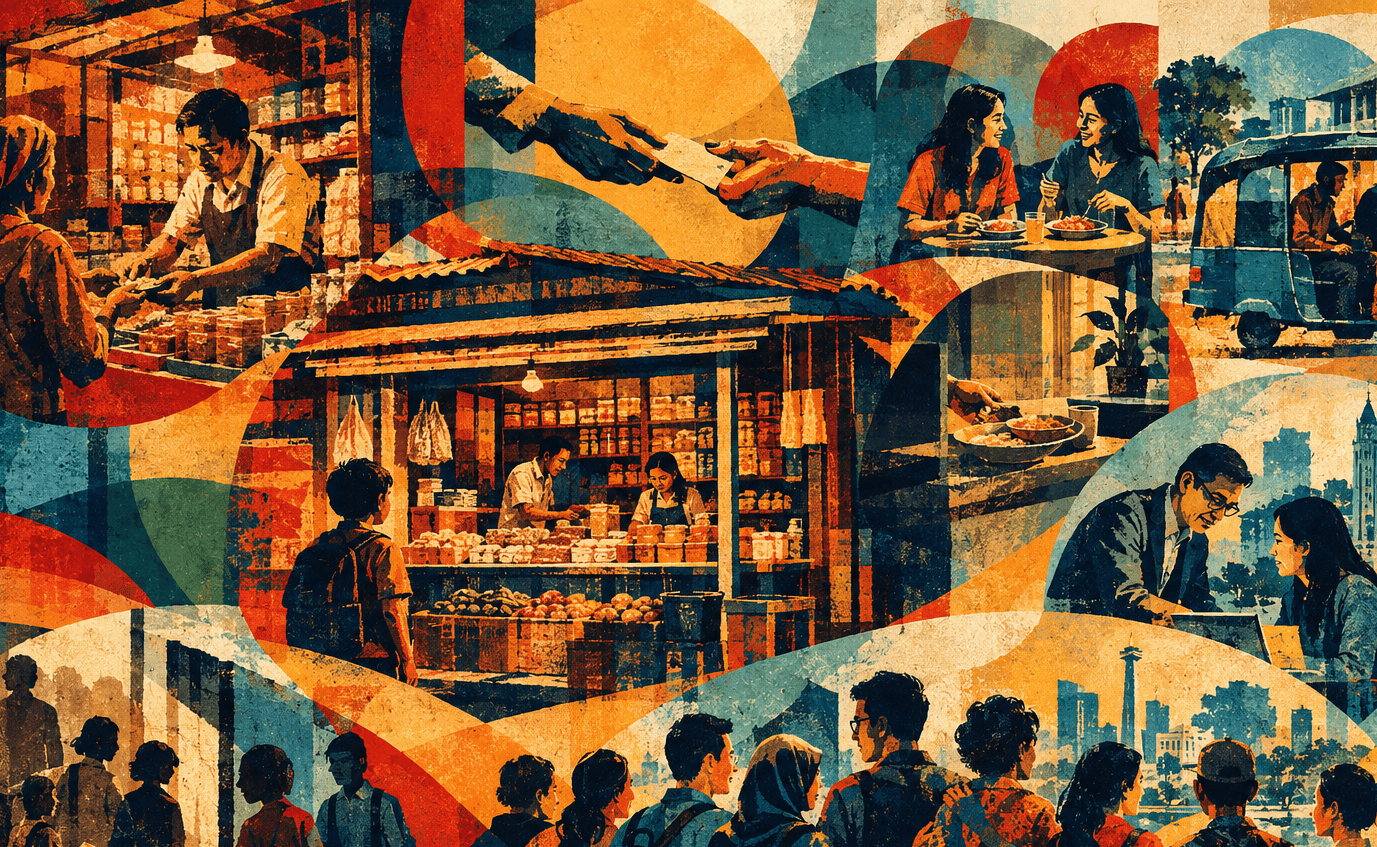
My less-than-positive impression of Chinese people was rooted in my childhood experience. It goes back to one particular place: a shop in the market. In my hometown in Boyolali, a single stall dominated the entire marketplace. It was owned by a Chinese-Javanese family. They were known for being the shop that never sold bad or slightly damaged products and the only one that never hesitated to raise prices to adjust to the economy. They gained respect from other shop owners and buyers for their quality maintenance and reliability in being the go-to shop that always opened, holiday or not. But it was their straightforward, no-nonsense attitude in dealing with people that bred fear, distance, and maybe jealousy, creating a wedge between us, the “real” Javanese, and them, the Chinese. I grew up with that mentality, and I honestly couldn’t envision how or in what form of life I would ever be connected or cross paths with Chinese people.
In hindsight, this market dynamic in Boyolali was not an isolated local phenomenon. It was the lived outcome of socio-political dynamics and New Order-era structural policies that pushed Chinese Indonesians predominantly into commerce while limiting their presence in public governance, military, or academia—effectively reinforcing an artificial distance between communities.
But as we know, life has a funny way of showing just how wrong we are at times.
Also read Indonesian-Chinese who grew up ‘out-of-wedlock’ in Suharto era relive ‘trauma’ through new book
In fact, it was a Chinese Indonesian colleague who loaned me the money to pay my tuition fee when I had nowhere else to turn. I was on the brink of quitting when she, without even asking whether I could pay back the money, decided to give me a loan. It was also a Chinese Indonesian university friend who often treated me to dinner at Ayam Taliwang in Blok M and offered to give me a ride in a bajaj after our class ended just because we headed in the same direction. She knew that with my mediocre salary, I couldn’t splurge to dine out or have the luxury of hailing a bajaj.
During my university years, I rented a room in Blok A from a Chinese Indonesian Muslim family who rescued me from hunger without making me feel like a charity case. There were countless occasions when they quietly left a plate for me in the kitchen, knowing how I often sneaked in at night looking for any leftover food to eat to fill my hunger. They also never made a big deal when I couldn’t pay my rent on time. They helped me without stripping me of my dignity. Fast forward a few years later, when I pursued my two master’s degrees in the USA, some of my closest allies were Chinese professors. They fought for my education and helped me navigate the turbulence of being a minority student in the Western world. They showed me the ropes that have helped me excel academically, and to this day, our relationship and mutual respect have formed into a good friendship.
And now, in my current profession as the founder of an education organization and a mentor, some of my most loyal and dedicated supporters are Chinese Indonesians. As I get to know them better and on a personal basis, I begin to see the sides that I failed to recognize before. Yes, the “flat or cold” exterior is still present here and there. Their communication style does not necessarily and immediately exude warmth like what we can normally easily pick up from other Indonesians. But when we take time to look deeper and pay closer attention to their way of showing care or affection, the answer lies in their actions. Because what they lack in words or body language, they make up for in real effort.
This realization got me thinking about understanding why we put a gap between us. Of course, there is always a story and history of wrongdoings in the past by both sides. We have witnessed the tragedies unfold and the sufferings born in the name of identity, nationality, and patriotism. Oftentimes, we recoil to ethnicity or minority status and use them as weapons and reasons to keep them at arm’s length. But if we think about it, aren’t we all minorities at some level, depending on where we draw the line? We are an Asian continent among other continents. We are Southeast Asia within the Asian continent. We are Indonesian within ASEAN countries. We are Javanese, Sumatrans, or Papuans within Indonesia. Even among Javanese, we are Central Java and not East or West Java. And the circle can get smaller and smaller down to the very fact that, in the end, we are simply different individuals.
Undoing that distance starts with a personal encounter.
So, my point is that maybe we need to assess the space that we put between us and start looking for what brings us closer rather than finding fault in each other. If you have not done it already, open yourself up more and learn to see the differences simply as different colors that make a beautiful painting. Because speaking from personal experience, deep down, there is a genuine desire to be embraced and to be seen as friends behind our façade. And if you are lucky, you can make a new friend like I did when working on this piece. When I shared my draft with Grace, she replied to my text, saying, “Darling, you have not met me and my friends!” That is neither a cold nor flat reply, but a warm and friendly one.
Sep 13, 2026 (Last modified: Sep 13, 2026)
Riyani Indriyati is the author of The Colours of Mothers, a collection of short stories about extraordinary mothers from around the world, published by Gramedia. Riyani is the founder of the Dahuni Foundation, an educational organization that provides scholarships and mentorships to Indonesian students. She was the editor in chief of Plaudit Magazine and has published opinion pieces in The Jakarta Post, Magdalene, Detik, and Suara Merdeka. Riyani was born in Boyolali, Central Java and currently lives in Porto, Portugal.
Latest Story
Sep 08, 2026
Aug 22, 2026
Aug 19, 2026
Aug 14, 2026
Call for Submissions
We welcome submissions across multiple genres including poetry, fiction, book reviews, cultural essays, and literary-focused features and opinion pieces. Please note that we only accept previously unpublished work. Accepted drafts may be edited in collaboration with our team before publication.
We’re excited to hear from writers at all stages of their craft. You can find our full submission guidelines here


Leave a Reply