Dakota Sinder
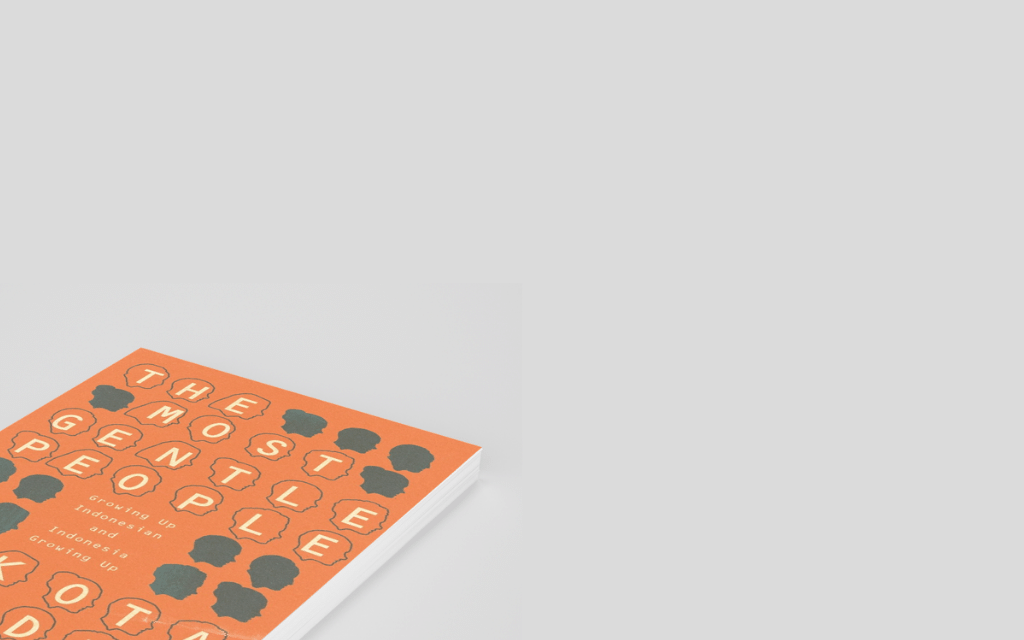
What does it mean to crave home when home is halfway around the world? In his forthcoming book, The Most Gentle People (releasing November 17, 2026), Jakarta-born writer Dakota Sinder retraces the modern Indonesian story—from colonial history and national turning points to a privileged childhood in Jakarta and the quiet discomforts of fitting into life in America.
In this excerpt, Dakota Sinder finds himself in New York, working a corporate job and desperately missing home. He heads to a small church bazaar in Queens looking for familiar sights and smells, only to find himself confronting something deeper: the awkwardness of slipping between languages, the legacy of cultural shame, and how heritage follows us even when we try to outrun it.
Read the piece below.
On a day off, I visited an Indonesian bazaar set up in a small church in Elmhurst, Queens. I was excited, yet also nervous. I craved Jakarta, and this was as close as I could get. Having worked my entire life to leave Indonesia, I now missed the corner Indomaret, home-cooked perkedel, and catnaps on the couch. Without any of that, was there anything to connect me to where I was from? When was the last time I spoke Bahasa?
I tried to get friends to come with me to the bazaar, but everyone already had plans. I wanted them to experience my homeland through the lens of our cuisine. More than that, I wanted someone to ask questions about everything and to ask me to speak Indonesian—someone to hold me accountable to my own culture.
Getting off the F train at Jackson Heights, as I walked to the bazaar, I thought of Idul Fitri with my extended family. The night before the festivities, our family would gather at Oma and Opa’s home. Hailing from West Sumatra, we were renowned for our homemade satay Padang. Lean cubes of beef tongue, generously slathered in thick curry gravy. While the adults skewered the meat, the cousins, Kian, and I hung out in the tearoom. With the fan on, barely, we’d bicker in a mix of Indonesian and English.
Reza would gripe: “Lu sombong, tahu nggak?” You’re arrogant, you know?
Kian would quip back: “Iseng iseng, bro, santai aja.” I’m just kidding, bro, just relax.
Occasionally, something in Japanese or Korean would be said—parroting our favorite anime or K-pop song. It was all fun and games until I chimed in with a bit of Bahasa. On cue, I’d be told how “American” my accent sounded, or how I came off as such a “Bule,” a pejorative term used to describe foreigners, typically White people. I’d sweat, silently, smiling, baring my teeth.
I tried not to let the jabs bother me, but they left their marks. Now, massaging my shoulder, I turned the corner and arrived at the bazaar.
The church had a little lawn, some fences, and an entrance adorned with stained glass. Smoke wafted from the side of the building, carrying the smell of cooked meats and other delicacies. The fumes smelled and felt like the voice of a parent, teacher, or other authority figure. Calm yet assertive.
Scampering up the steps, I was surprised by the crowded room. Who knew that this many people were interested in Indonesia? By this point, I’d gotten used to people asking if Indonesia was a place in Bali.
The church also functioned as a basketball court, with a hoop at the back. The food stands followed the out-of-bounds line, forming a neat rectangle. Tables and seating crowded center court. I warmed up by taking two laps around the premises to observe the queues and, more importantly, the food.
The first counter I went to had delicacies from West Sumatra. Most of the fresh fare was gone by then; mainly packaged goods were left. There were two things that I recognized, but I could only recall the name of one. Tempeh, my favorite food, and rempeyek, which I blanked on. The stand was operated by what looked like a mother and her two sons. The teens were shooting fadeaways and discussing basketball as they attended to the customers. When it was my turn, I fumbled my words.
“Satu ini dan satu itu.” One of this and one of that.
While what I blurted was true, it was not what I intended. The boy, noticing my frustration, responded in English.
“Of course. Here you go. Will that be all?”
How infuriating! The last thing I asked for was for him to out me for my poor Bahasa skills. Even worse, he smirked as if he’d done me a favor. I had no choice but to smile politely and continue in English.
I squeaked a quiet “terima kasih,” thank you, as I walked away.
Flustered, I realized I had only bought snacks, not a full meal. I walked around again. I stopped at another stand to get some nasi goreng ayam. It was something familiar, so I figured I could execute my order this time without a hitch. As I waited in line, I was drenched from pacing around and being nervous. I thought to myself, “Maybe what tethers me to my home isn’t the language or food, but the persistent perspiration.” Gross.
When I got to the front, I noticed there was none left of what I was planning to order. My prepared script was no longer relevant, so I took a breath. At that moment, maybe the familiar face of doubt resurfaced, or perhaps it was something else, but the lady behind the stand began to speak up in English.
Initially, I was upset again, but then I thought, maybe she is trying to connect with me as much as I am with her. Maybe she is far away from home like I am, but she, too, is trying to make this more than just a transaction. I cast my shame to the side and began to ask her what everything was. Our conversation lingered for a bit, and I ordered some white rice, a chicken leg, some spicy sambal, and a Teh Kotak.
“Come back again. I’ll see you next time!”
“Yes. I think I will. See you then!”
Satisfied with my minor but meaningful victory, I finished the meal outside on the lawn. It was a nice, lukewarm day—cool wind, warm sun. I was so fixated on confirming my cultural identity that I almost missed the moments to authentically connect. That discomfort still clings to me, the same shame that permeated each bead of sweat on that night with my cousins.
Food and language have a prickly relationship in my memory. Like most children, I was a fussy eater. At home, I would only eat tempeh or beef with rice, with a side of carrots, broccoli, or simple greens. The vegetables never mixed with the rest of the meal. I only ate those after finishing my rice and protein. Outside of the house, I was even more restricted. McDonald’s was the go-to. I’d always get a plain burger with fries, no condiments. Never the chicken nuggets. Even at a young age, I recognized that the soggy, orange-crusted pink stuff was one step too far from Mother Nature’s wishes.
At family gatherings, with my greasy brown paper bag in tow, relatives would stare with bulging eyes and sly smiles. Sometimes, they couldn’t hold it in, oh anak bule, nggak suka makanan indo, “Oh, the White kid doesn’t like Indonesian food?”
They were wrong. They saw what they wanted to see.
I didn’t like any food, except for the small, approved menu at home. I was a fixated, obsessive, picky eater. In other words, I was a kid. I’d slink by, silent, nodding and smiling as if I was in on the joke. I wouldn’t dare speak back in Bahasa, lest I want them to also poke fun at my accent.
Although I’d hesitate to speak up at family gatherings, my inner monologue always danced between English and Bahasa. I often wonder what language other people think in. When writing, I primarily ponder in English, although my syntax subconsciously follows Indonesian grammar. When doing math, I count in Bahasa.
If you only understand one language, then you may be predisposed to believe that language is limited by the world surrounding us. If you understand multiple languages, you come to realize that it is the world around us that is limited by language. For instance, between English and Indonesian, there are certain words and sayings that simply do not translate well or at all. Gemes is one of those. Have you ever been overcome by the intense desire to pinch a baby’s cheeks? That’s gemes. Psychologists call this phenomenon “cute aggression.” I wonder if the first colonists looked at us and our land and felt a perverse sense of gemes. Were we so adorable that they had to squeeze everything out of us?
If language creates and contorts the world, then it is not only a vessel of meaning but also a vehicle of power. Those who control language control the world. Richard Wright examined this firsthand when he visited Indonesia in 1955.
Wright, a well-known Black writer and intellectual, made his way over for the Afro-Asian Conference, also known as the Bandung Conference. Twenty-nine countries from across Asia and Africa participated, representing more than half of the world’s population. It was a declaration of solidarity between various nations that had once been under the oppression of imperialism. It was a stance against neocolonialism, the idea that the “developed world” would try to unfairly extract value out of the “developing world.” Spoiler alert: they were right. The conference laid the foundations for the Non-Aligned Movement, which promoted neutrality against manipulation by the United States and the Soviet Union. You can guess how the U.S. felt about this.
During his visit to document the conference’s progress, Wright came across a colonial-era booklet, Populair Maleis, intended to teach the local lingo to foreigners1. To his surprise, the document contained little to no language that would allow for conversation. Rather, it was mostly comprised of orders to servants, almost exclusively ending with exclamation marks. Like this! Language was reduced to a set of commands. Press one button to make us do this. Press another to make us do that. Beep, bop, boop: Here is your food, Master.
Such perversion of language prevents meaningful relationships. This, in turn, creates the façade that an emotional and intellectual gap exists that cannot be bridged. In the way we use a limited vernacular when talking to a toddler, the colonist is instructed to do the same when addressing a “Native.”
Wright’s discovery proved to be prescient and haunting. The toxic discrimination and segregation of the colonial era have a long half-life. Still emitting radiation, we continue to inhale their fumes today. While my relatives’ remarks offended me, I was aware that there were advantages to my poor Bahasa skills. The worse I sounded, the more I seemed like a foreigner. The more foreign I presented, the more I was perceived to be superior. A part of me wished to fully commit to being Indonesian to absolve myself of their insults, while another side recognized the trade-offs to forgoing my Whiteness.
My childish desire to be cool ultimately won out. Coolness is a proxy for power. Being White was cool. With Whiteness came power, and with power came wealth. With all that, came friends with more Pokémon cards, tastier snacks, new shoes, and bigger houses to explore on play dates. I wanted to be engulfed by and emit Whiteness myself. Despite my best efforts to disassociate from my culture, the body keeps count. The past pangs when the present touches its bruises.
1 Wright, The Color Curtain, 179 – 182
Nov 05, 2026 (Last modified: Nov 05, 2026)In this article The Most Gentle People
Dakota Sinder is a writer from the Big Durian—Jakarta. He is Indonesian, American, Jewish, Muslim, and a Zillennial. His first book, The Most Gentle People, is a story about growing up Indonesian, and Indonesia growing up. He is the author of two newsletters: Indo Nesos and Just a Kid from Jakarta. You can also find his writing in Slant’d Magazine, Inside Indonesia, and elsewhere. Outside of creative work, he coaches youth soccer in Queens, hangs out with his two cats, and enjoys photography. Currently, he also serves as a contributing editor for IDWRITERS.
About "The Most Gentle People"
The Most Gentle People is a story about growing up Indonesian, and Indonesia growing up. This book recasts Indonesia—from the Dutch slave markets of Batavia to the U.S.-backed mass killings of 1965, and into Sinder’s privileged Jakarta childhood and challenges to fit in America—this is a new retelling of the Indonesian story. The Most Gentle People illustrates that we cannot understand ourselves without understanding history, and we cannot understand history without understanding Indonesia. The Most Gentle People will be released on November 17th, 2026.
Latest Story
Nov 05, 2026
Sep 08, 2026
Aug 22, 2026
Aug 19, 2026
Aug 14, 2026
Call for Submissions
We welcome submissions across multiple genres including poetry, fiction, book reviews, cultural essays, and literary-focused features and opinion pieces. Please note that we only accept previously unpublished work. Accepted drafts may be edited in collaboration with our team before publication.
We’re excited to hear from writers at all stages of their craft. You can find our full submission guidelines here


Leave a Reply