We tend to think of disasters as events that arrive from somewhere outside ordinary life. A flood comes, a forest burns, a mountain erupts, a house collapses, and only afterwards do we begin the familiar work of documentation: counting casualties, measuring hectares, listing damaged infrastructure, and calculating economic losses. The disaster becomes a number, then a report, and eventually an archive. Our conventional understanding of catastrophe is therefore fundamentally retrospective. Something happens first. We record it afterwards.
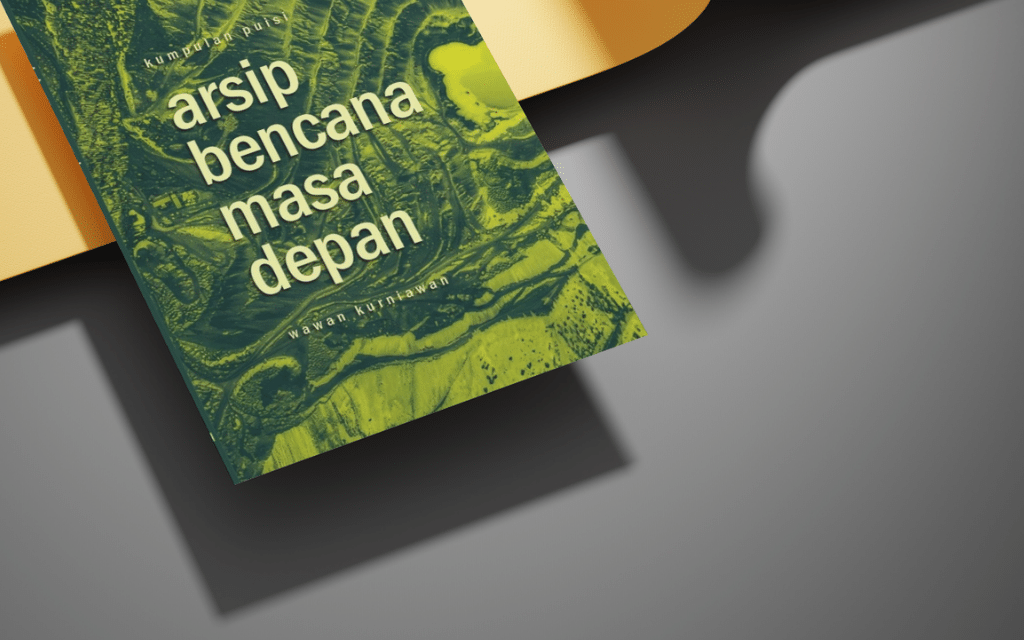
Wawan Kurniawan’s Arsip Bencana Masa Depan begins by quietly reversing that sequence. Its title proposes an archive of something that has not yet happened, an apparently impossible object that nevertheless makes an unsettling kind of sense in a country where the conditions of catastrophe are often visible long before the catastrophe itself arrives. Published by Jual Buku Sastra in 2026, this 64-page collection brings together ecological destruction, disappearing landscapes, mining, anxiety, loss, and human alienation. Its central proposition is both simple and disturbing: the future may already be accumulating evidence of its own destruction in the present.
The title is therefore not simply poetic. It is an argument about time, evidence, and responsibility. If an archive normally belongs to the past while disaster belongs to the future, what happens when the two are forced into the same sentence? Perhaps what we call an approaching catastrophe is simply the continuation of processes already underway, with enough evidence accumulated along the way that its eventual arrival should come as no surprise. This is what makes Wawan’s collection more interesting than a straightforward book of environmental poems. Rather than merely asking readers to worry about what might happen to the planet, it invites them to reconsider how much of that future has already been produced by the present.
The question becomes particularly urgent when placed alongside Indonesia’s environmental record. The Ministry of Forestry reported approximately 175,400 hectares of net deforestation in 2024. Meanwhile, environmental organisation Auriga Nusantara estimated that forest loss reached 433,751 hectares in 2025, a 66 per cent increase from its own 2024 estimate. Although these figures employ different monitoring methodologies and should not be treated as directly interchangeable, they reveal the scale of pressure on Indonesia’s forests. The problem is no longer simply whether environmental destruction can be documented. It is whether the existence of such documentation changes the decisions that allow destruction to continue.
The Archive of a Disaster That Has Not Happened Yet
The opening poem, “Siapa Lagi yang Akan Berdiri di Dermaga?” (“Who Else Will Stand at the Dock?”), dedicated to Helmud Hontong, establishes the collection’s relationship between place, memory, and ecological loss. The poem moves through Tahuna and Gunung Sahendaruman, recalling birds, forests, rivers, and the possibility of a future in which the landscape becomes inseparable from disappearance. Its geographical references matter because they prevent environmental destruction from becoming an abstract concern. Tahuna remains Tahuna; Sahendaruman remains a particular mountain with its own histories and relationships to the people who inhabit the surrounding landscape.
The dedication to Hontong gives the poem a political dimension that extends beyond personal mourning. Hontong was the Deputy Regent of the Sangihe Islands and a vocal opponent of the gold mining concession granted to PT Tambang Mas Sangihe. Before his death in June 2021, he had reportedly sent a letter to the Ministry of Energy and Mineral Resources expressing his objection to the mining permit. His sudden death aboard a flight from Denpasar to Makassar prompted environmental activists and the National Commission on Human Rights to call for an investigation. The police subsequently reported that the autopsy found no evidence of poisoning and attributed his death to complications from a chronic illness. These findings should be acknowledged, particularly because the political significance of his opposition must not be confused with an unsubstantiated claim about the circumstances of his death.
Yet the question of silencing does not disappear simply because an allegation of political murder cannot be established. Hontong’s death meant that a public figure who had challenged the mining concession could no longer speak, object, or participate directly in the political struggle. The questions he raised, however, did not disappear with him. Wawan’s dedication becomes meaningful because it returns his name to the landscape and refuses to separate the memory of the individual from the environmental conflict in which he participated.
The poem’s language makes this connection particularly visible through the phrase sebelum bersaksi (before bearing witness). To testify is not simply to remember. It is to communicate what has been witnessed, preserve a record of experience, and prevent something from disappearing into silence. The verb gives the poem an ethical dimension that exceeds personal grief. The image of those who wish to mine the earth’s body, which Hontong had sought to protect, establishes an opposition between extraction and care. The earth is not merely a resource waiting to be exploited; it is a landscape to which human beings maintain relationships of responsibility.
The dock becomes another powerful image in this process. As the poem closes, the landscape continues to receive the waves while remaining faithful to the possibility of finding the person who is gone. The person may no longer return, but the place continues to remember. This is where the poem acquires its significance as a form of literary resistance. Literature cannot reverse a death, replace political accountability, or substitute for environmental activism. Nevertheless, it can resist the erasure of the struggle that preceded an individual’s absence. When a voice can no longer speak directly in the political arena, poetry can preserve the memory of what that voice once challenged. Wawan does not need to establish a new historical explanation of Hontong’s death to make his poem politically meaningful. By keeping the conflict over Sangihe present in the reader’s imagination, he refuses to allow the environmental question to disappear with the person who once defended it.
Beyond Environmental Grief
Although ecological anxiety provides an important foundation for the collection, its poems do not remain within the familiar territory of environmental lament. “Anima Animus”, for instance, moves towards a more intimate vocabulary of the body, injury, and divided subjectivity. It begins with a flower growing inside the speaker, its leaves and thorns becoming inseparable from the body. The image gradually turns towards wounds and blood, until the distinction between happiness and suffering becomes uncertain. The flower, conventionally associated with beauty and regeneration, carries its own capacity to wound. Growth and injury are no longer opposing conditions but experiences that inhabit the same body.
This relationship between the external environment and the internal self is important because Wawan does not treat ecological destruction as a problem that exists somewhere outside human experience. The damaged landscape has an interior counterpart in the fractured subject. The collection’s concern with extinction consequently extends beyond the disappearance of forests and animals towards the emotional and psychological conditions through which people experience a world that is increasingly difficult to inhabit.
Other poems extend this unease into questions of political power and personal agency. “Imaji yang Lari” moves between the speaker’s difficulty in understanding the self and an awareness of the political world. Its reference to paper aeroplanes becoming poems read by members of parliament introduces an ironic relationship between literary expression and political authority. Poetry may enter the institutional space of power, but its presence there does not necessarily mean that its criticism will be heard or acted upon. It may be read, handled, and eventually left without consequence. The poem thus raises a question about the relationship between speaking and being heard, between the circulation of an idea and its capacity to challenge the conditions that produced it.
This tension also appears in “Hampa yang Kutulis Berulang”, where writing becomes an attempt to confront emptiness without necessarily overcoming it. The repeated act of writing suggests persistence, but it also exposes the limitations of language when the speaker struggles to establish a meaningful relationship with the world. These poems complicate the collection’s environmental concerns by showing that catastrophe can also emerge through alienation, political disillusionment, and the difficulty of sustaining a sense of agency.
The wider organisation of the book reinforces this movement. Titles such as “Operasi Rahasia Penguasa”, “Telinga Palsu 1997 dalam Parade”, “Mengenang Maret”, and “Elegi Kecemasan” indicate a literary world in which environmental concerns coexist with historical and political memory. The collection does not provide one explanatory framework for all these experiences, nor does it need to. Its more interesting achievement lies in allowing different forms of damage to appear alongside one another without pretending that they are identical.
The Disaster We Keep Calling Natural
There is a phrase that repeatedly appears whenever catastrophe becomes politically inconvenient: natural disaster. The phrase sounds descriptive, almost innocent. A flood is natural. A landslide is natural. A forest fire is natural. Yet the word “natural” can close an argument before the political questions have even been asked. It directs attention towards the immediate event while potentially obscuring the decisions that have made particular communities and landscapes more vulnerable.
Wawan’s collection makes this closure difficult to sustain because it is interested not only in the moment when destruction becomes visible, but also in the conditions that allow it to occur. The mining controversy in Sangihe provides a concrete example. The concern is not simply that an island might experience environmental change. It is that decisions about land, resources, and development can determine who benefits from extraction and who bears its consequences. Hontong’s opposition to the mining concession makes the poem’s dedication politically significant: the future of a landscape is inseparable from the conflicts over who has the authority to decide its use.
The scale of Indonesia’s forest fires provides another dimension to this concern. According to the Ministry of Forestry’s SiPongi monitoring system, approximately 359,619 hectares were affected by forest and land fires in 2025. Although this was lower than the area recorded in 2024, it remains a substantial loss. Such figures remind us that environmental destruction is not always a single spectacular event. It can emerge through the interaction of dry conditions, land management, human activity, and inadequate prevention. The weather can become the immediate trigger without being the author of the entire disaster.
Environmental scholar Rob Nixon describes this gradual form of destruction as slow violence: damage that unfolds over time, remains difficult to recognise as an immediate event, and often escapes public attention until its consequences become extensive. The concept is useful for reading Wawan because the collection repeatedly shifts attention away from spectacular catastrophe towards the processes that precede it. The destruction of a landscape may take years, while the political decisions that enable it can be dispersed across institutions, policies, and economic interests. By the time the damage becomes visible, its causes may already have been normalised.
“Ekologi Sebuah Kenangan” offers a particularly suggestive way of understanding this gradual destruction. The poem incorporates visual material resembling Google Doodle images, accompanied by dates from 1986, 1998, and 2020. Its verbal and visual elements place different moments beside one another, suggesting that ecological transformation is not always experienced as one dramatic event. The poem describes destruction as something that takes place quietly, while loss continues to spread through the body of the earth. The image of a growing seed of loss is especially unsettling because it reverses the familiar association between seeds and regeneration. What grows is not necessarily life; it may also be the accumulated consequence of destruction.
The book’s use of visual materials, maps, and QR codes further complicates the relationship between literary imagination and recorded evidence. These elements extend the reading experience beyond the conventional arrangement of printed poems. The map accompanying the title poem, for instance, gives geographical form to the idea of an archive, while the visual sequence in “Ekologi Sebuah Kenangan” makes changes in time available for comparison. The book does not become an environmental report simply by incorporating these materials. Instead, it brings different modes of representation into conversation, suggesting that ecological memory requires more than one way of seeing and recording the world.
When Poetry Refuses to Forget
An archive is never simply a neutral collection of information. Someone decides what deserves to be preserved, what is considered important enough to document, and what can be left outside the record. This is particularly relevant when environmental destruction affects communities whose experiences are not always adequately represented in official documentation. The loss of a forest, for instance, cannot be fully understood through the number of hectares destroyed. Such measurements may register physical damage, but they cannot necessarily preserve the cultural knowledge, memories, relationships, and histories attached to the landscape.
Wawan’s collection does not attempt to replace environmental reports or scientific evidence. Its contribution lies in making perceptible the experiences that numerical records cannot fully communicate. Statistics can tell us how many hectares of forest have disappeared, but they cannot necessarily tell us what it means for a community to lose the landscape through which its memories, knowledge, and everyday relationships have developed. Poetry offers another kind of record, one that preserves the emotional and cultural dimensions of environmental change.
This is also why the dedication to Helmud Hontong matters beyond its commemorative function. By remembering the person alongside the place he sought to protect, Wawan prevents the environmental conflict from being reduced to a technical disagreement over mining permits. The poem restores a human presence to a dispute that might otherwise be described primarily through investment, licensing, and regulatory procedures. Its resistance lies in refusing to allow the struggle to disappear from public memory.
The political importance of this gesture becomes clearer when we consider the possibility of forgetting. Once a forest disappears, its absence may still be visible. But when the history of its disappearance is forgotten, destruction can be rewritten as inevitability. A mining concession becomes development, a forest fire becomes a matter of weather, and the displacement of a community becomes an unavoidable consequence of progress. Language makes these transformations possible because it determines which relationships remain visible and which responsibilities disappear from the account.
Wawan Kurniawan’s Arsip Bencana Masa Depan is most compelling when it refuses the comforting distance of environmental concern and makes catastrophe feel like a problem of proximity. Sangihe is not somewhere else. The people who defend its landscape are not anonymous figures in a general narrative of environmental resistance. Their struggles belong to particular histories, and their memories deserve to remain part of the public conversation. Through poetry, Wawan gives those histories another place to speak, even when the people who once carried their voices are no longer present.
Perhaps this is what makes an archive different from a warning. A warning says that something might happen. An archive suggests that the evidence has been available all along. The question left by Arsip Bencana Masa Depan is therefore not simply whether disaster will arrive, but what we will say when the future finally opens the archive and discovers that we already knew.
Nov 15, 2026 (Last modified: Nov 15, 2026)In this article Arsip Bencana Masa Depan Wawan Kurniawan
A review of Arsip Bencana Masa Depan, by Wawan Kurniawan (Jual Buku Sastra, 2026)
Desca Angelianawati PAUL, also known as Desca Ang, is a lecturer and research assistant based in Indonesia. She enjoys reading, writing, and reviewing books with John Denver and Connie Francis as her soundtrack.
Latest Story
Nov 15, 2026
Nov 13, 2026
Nov 05, 2026
Sep 08, 2026
Aug 22, 2026
Aug 19, 2026
Call for Submissions
We welcome submissions across multiple genres including poetry, fiction, book reviews, cultural essays, and literary-focused features and opinion pieces. Please note that we only accept previously unpublished work. Accepted drafts may be edited in collaboration with our team before publication.
We’re excited to hear from writers at all stages of their craft. You can find our full submission guidelines here


Leave a Reply