Relasi Kuali
On an unassuming dining table, a plate of rice and a glass of milk are often seen merely as ways to quench thirst and stave off hunger. We sit, take a bite, and carry on with our day. Yet, if we pause to trace the origins of a single grain of sticky rice or the green beans on our plate, we encounter a sprawling history of human stories, rooted traditions, conflict, and warmth.
This very awareness breathes life into Relasi Kuali. Operating under the Effington Media line, Relasi Kuali is not a platform preoccupied with recipe measurements or awarding stars to fine-dining restaurants. It is an alternative essay publication—a space to grow and weave stories through the medium of taste and culinary culture. For them, food acts as both a sociological lens and a sharp dialectical tool.
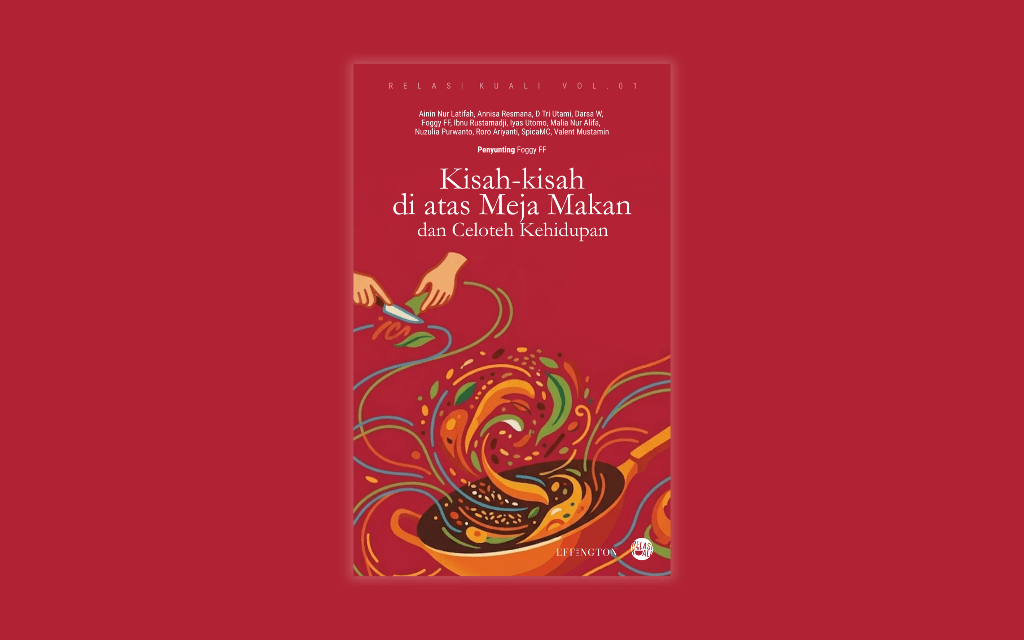
Having steadily built its presence since its introduction last June, Relasi Kuali teamed up with Effington Books this August to release a printed anthology. The debut volume, titled Kisah-Kisah di Atas Meja Makan dan Celoteh Kehidupan (Stories on the Dining Table and the Chatter of Life), compiles 15 early pieces from 12 different writers, all previously published on the Relasi Kuali website. These authors include Ainin Nur Latifah, Annisa Resmana, D Tri Utami, Darsa W, Foggy FF, Ibnu Rustamadji, Iyas Utomo, Malia Nur Alifa, Nuzulia Purwanto, Roro Ariyanti, SpicaMC, and Valent Mustamin.
The anthology is slated for a quarterly release. Presented in the signature pocketbook format of Effington Books, this print edition serves as a physical companion to the already running digital version.
The web platform and the book finally found their first public stage on Wednesday (August 19, 2026), through a discussion session hosted by the Bicara Passion platform. The event was more than just a book talk; it acted as an unofficial public introduction to the Relasi Kuali platform and website, while also marking the physical launch of their work.
To unpack the narratives within the book, three contributing writers took the stage. Foggy FF, founder and editor-in-chief of Relasi Kuali representing Effington, was joined by two writers who are also part of the editorial team: Ainin Nur Latifah and Malia Nur Alifa.
For Foggy FF, who frequently shares her thoughts on child education and women’s rights, food offers the best vantage point to tackle macro-level discourse. Evolutionarily, the ritual of eating together has been proven to build a sense of security and release happiness hormones. Since ancestral times, sharing a meal has signaled peaceful intentions. Yet, digging deeper, the dining table harbors an existential challenge.
Foggy draws a stark line connecting food crises to the domestication of women. For centuries, patriarchal narratives have shrunk the kitchen into a mere domestic enclosure—a symbol of submission and a site for unpaid reproductive labor. In reality, the kitchen functions as the primary arena where power dynamics operate. To discuss what is served on the table is to unmask the landowner, the supply chain holder, and the controller of the seeds.
“The exploitation of nature and food resources often runs parallel to the exploitation of women’s labor,” Foggy notes. Through the name Relasi Kuali—a satirical play on the jargon “relasi kuasa” (power relations)—she challenges the public to dismantle these archaic narratives. Cooking must be restored to its rightful status as a survival skill and a daily political manifesto. Taking control of the wok in the kitchen ultimately means taking control of life’s narrative.
This challenge extends from the household kitchen straight to the tables of state policy. Ainin Nur Latifah critically dissected national food policies, focusing heavily on massive agricultural projects like the food estate.
The rhetoric surrounding these large-scale food baskets is often driven entirely by capitalist economies of scale, sidelining local wisdom and seemingly repeating past ecological failures. Ainin cast a sharp spotlight on land clearing in Papua. There, the forest is not merely a collection of trees; it is a living space, a natural pharmacy, and the cultural identity of indigenous communities. Massive projects that obliterate this landscape carry a severe risk of uprooting locals and turning them into day laborers on their own ancestral lands.
True food sovereignty, Ainin emphasized, is actually rooted in family farming. This practice relies on local communities and mutual support networks. She also pointed out the bitter reality of credit traps quietly strangling smallholder farmers, making younger generations in rural areas increasingly reluctant to step into the rice fields.
While Ainin dismantled modern policy, Malia Nur Alifa took the audience back to the 19th century through her historical research. Malia traced how Lembang, West Java—originally a coffee plantation propping up the Dutch colonial treasury (Cultuurstelsel)—underwent a drastic transformation in October 1899.
Under the Surya Sumirat Colony program, the colonial government brought 11 families from Semarang and Cirebon to clear land for European vegetables. Cabbage, carrots, and beans suddenly sprouted in Lembang soil, replacing the local diet that had previously relied heavily on native tubers (beubeutian).
The history of pure milk is equally startling. In the 17th and 18th centuries, indigenous people viewed cow’s milk as “white blood,” considering it highly taboo to consume. It took extensive research and crossbreeding of cattle from Friesland to Australia to build the Lembang dairy industry we know today. Ironically, this historic agricultural layout is now slowly eroding. Productive farmlands are being pushed aside, repurposed into modern tourist zones and homestays simply to satisfy the fleeting aesthetic demands of travelers.
From Foggy’s framing of the kitchen as an arena of power, to Ainin’s critique of macro-level food sovereignty illusions, and Malia’s dedication to tracing the historical roots of Lembang’s commodities, all three perspectives converge on a single understanding: food issues are never one-dimensional. A meal is the product of tangled histories, political policies, and hard labor that often escapes the naked eye.
The presence of this digital platform, alongside the pocketbook featuring narrative essays, is an intentional strategy. Relasi Kuali aims to ground heavy discourse, placing it right into the hands of readers, and restoring literary culture to public spaces.
A single plate of food carries a complete philosophy: where the source of life originates, who sweat to cultivate it, and how sociological structures either oppress or protect it. With the launch of this publication space, Relasi Kuali reminds us that every bite of food is the result of ecological defense, preserved collective memory, and a resistance that must be continuously nurtured.
Aug 22, 2026 (Last modified: Aug 22, 2026)In this article Kisah-kisah di atas Meja Makan dan Celoteh Kehidupan Foggy FF
Relasi Kuali is a storytelling platform that uses essays and non-fiction features to explore the profound cultural, ecological, and historical significance of food and the domestic sphere. It serves as a dialectical medium to preserve humanity's collective memory and cultivate empathy, encouraging readers to rethink what and how we eat while honoring the diverse, everyday struggles that sustain life.
Latest Story
Sep 08, 2026
Aug 22, 2026
Aug 19, 2026
Aug 14, 2026
Call for Submissions
We welcome submissions across multiple genres including poetry, fiction, book reviews, cultural essays, and literary-focused features and opinion pieces. Please note that we only accept previously unpublished work. Accepted drafts may be edited in collaboration with our team before publication.
We’re excited to hear from writers at all stages of their craft. You can find our full submission guidelines here


Leave a Reply