IDW
The Title That Diagnoses Its Own Illness
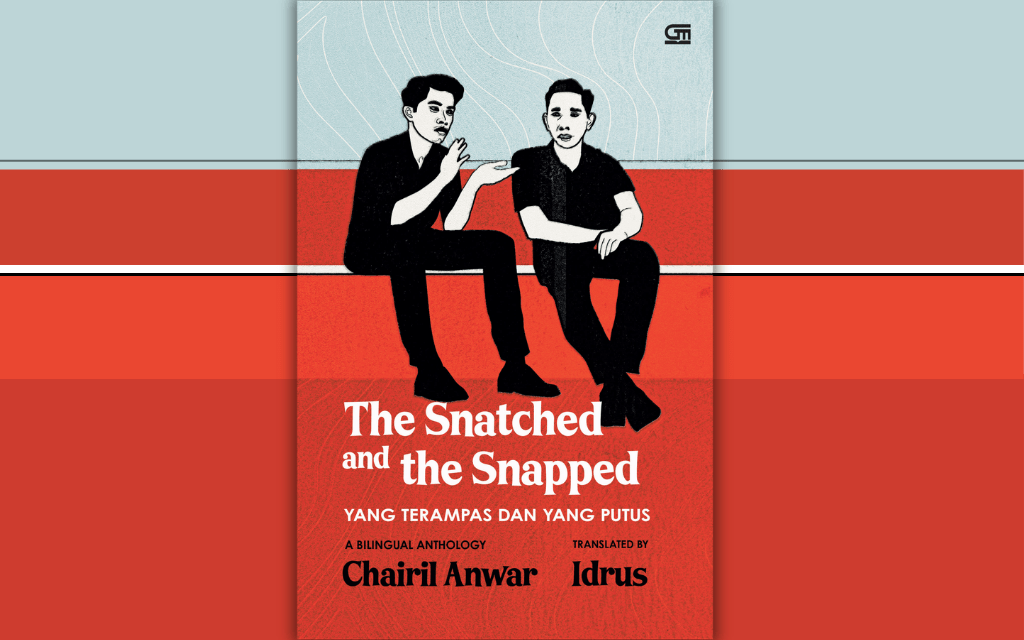
Before a single poem appears, the title has already made a confession. The Snatched and the Snapped is Rick Idrus’s rendering of “Yang Terampas dan Yang Putus,” the title of one of Chairil Anwar’s late, elegiac poems, and the decision to let that single poem’s title govern the entire anthology is either the most self-aware editorial choice in the book or the most unintentionally damning one. Terampas carries the sense of something violently seized, wrenched away by force rather than lost through neglect. Putus carries the sense of a clean break, a severing, the kind of finality that leaves no possibility of mending, the word Indonesian speakers reach for when a relationship ends or a rope snaps. Snatched and snapped are serviceable English equivalents, close enough in register and just alliterative enough to survive as a title. But the choice to make this phrase the anthology’s banner, rather than something drawn from Chairil’s more famous lines, “aku ini binatang jalang” or “aku mau hidup seribu tahun lagi,” signals that the editorial team understood, at some level, that violence and loss were the more honest frame for what this project actually is.
That is because the title, whether by design or by accident, describes the anthology’s own method with uncomfortable precision. Every translation in this collection is an act of snatching, something is taken from the Indonesian original and relocated into English, and an act of snapping, something is severed in the process and left behind on the far side of the language boundary. The book’s preface never states this explicitly. Novita Dewi’s introduction spends its energy establishing literary pedigree, invoking Burton Raffel’s early praise of Chairil as a major poet by international standards, tracing the father-son translation lineage back to A. Idrus’s Monash thesis, and framing the whole project as an act of filial devotion, “like father, like son.” What it does not do is sit with the title’s darker implication, that devotion and violence are not opposites here but nearly the same gesture. To translate Chairil at all, this title admits without quite meaning to, is to snatch him from one linguistic and historical world and snap him loose from whatever in that world refused to survive the move.
There is also a quieter irony buried in the title’s double structure, snatched and snapped, past participles describing something done to the poems rather than something the poems do. Chairil Anwar’s own poetic persona, across nearly the entire collection, is active rather than passive. The speaker of “Aku” refuses to be carried off passively, insisting he will keep running and raging even as bullets pierce his skin. The speaker of “Kepada Kawan” issues commands, fill the glass, break through the world, bury the dagger. Chairil’s Indonesian is a language of verbs hurled forward, of a poet who does things to the world rather than absorbing what the world does to him. A title built from two passive participles, snatched, snapped, done unto rather than doing, sits at a strange angle to that voice. It is possible to read this as thematically apt, since the poem “Yang Terampas dan Yang Putus” itself marks a late, weary turn in Chairil’s short career, a movement from defiance toward exhaustion, written the same year he died. But it is also possible to read it as symptomatic, a title that unconsciously tells us the translator’s real relationship to this material is one of receiving and processing rather than actively wrestling with it, snatching lines across the language gap and hoping the seams do not show.
What makes the title genuinely interesting, rather than merely evocative, is how literally it ends up describing the anthology’s translation choices once you start reading closely. Words get snatched from one cultural register and relocated into another that does not quite fit, the Dutch sonder becoming the French sans, a choice examined at length below. Words get snapped clean off entirely, historical and political weight left behind because the target language offered a smoother, blander equivalent, merdeka reduced to the generic freedom, iseng flattened into a simple loneliness it does not actually mean. The title poem itself, when read closely, turns out to be full of exactly this kind of quiet severing, coinages like mempesiang losing their strangeness in translation, geographically and emotionally loaded phrases like daerahku y.a.d. losing their precariousness. In each case, something is taken and something is left broken behind, which means the anthology’s title is not simply a translated phrase borrowed from one poem among many. It is an accurate, if unintended, description of everything the book does to Chairil Anwar for the next hundred and some pages. A more cynical reader might even suspect the title functions as a preemptive alibi, naming the violence upfront so that later encountering its evidence feels less like discovering a flaw than confirming a warning the book gave you at the door. Whether that is generous or too generous is a question this review keeps returning to, because the anthology itself never quite decides which kind of book it wants to be, one that owns its losses or one that hopes nobody counts them.
Careless Is Not the Same as Callous
The editor’s note structures its entire defense of the son’s revisions around exactly two examples, and the choice of examples is itself worth scrutinizing before accepting their conclusions. In “Aku,” the father’s translation of the poem’s hardened, unfeeling stance uses careless, a word suggesting inattention, a failure to notice rather than a deliberate refusal to feel. The son revises this to callous, and the distinction is genuinely load-bearing. Careless implies a speaker who has not thought about the consequences of his indifference. Callous implies a speaker who has thought about them and hardened himself against them anyway, which is precisely the posture of the poem’s central image, a wild beast cast out from its own pack, running with bullets in its skin, determined to keep moving until all the pain disappears and it becomes even less inclined to care. This is not a cosmetic fix. It relocates the poem’s emotional centre from accident to intention, from a speaker who simply is a certain way to a speaker who has made himself that way through sheer will, which is consistent with everything else “Aku” is doing, since the poem’s real subject is not indifference but self-authored hardness, the deliberate cultivation of a wild, uncontainable selfhood. On this single word, the son’s revision earns its keep.
The second example, from “Nisan,” follows a similar pattern. The father’s translation reads the speaker’s response to his grandmother’s death as sadness. The son insists this misses the poem’s actual emotional architecture, that the speaker is not sad in any simple sense but rather struck with pity, in awe of the grandmother’s willingness to accept whatever death brought her, positioned somewhere between grief and reverence rather than ordinary mourning. Read against the poem’s closing lines, which describe the grandmother reigning above dust clouds and pity itself, seated on a kind of throne built from acceptance, the son’s reading holds up. Sad flattens a complicated devotional awe into a generic emotion. Pitying, or something closer to compassionate reverence, preserves the specific shape of what the poem is actually doing, a young man startled into respect rather than simply grieving.
Both examples are genuine improvements, and if this were a book of two poems rather than dozens, the anthology’s confidence in its own method would be entirely earned. But the editor’s note treats these two corrections as representative rather than exceptional, as proof of a consistent interpretive rigor applied across the whole collection, and the rest of the anthology does not bear that claim out. Consider “Merdeka,” a title left untranslated in the Indonesian original poem’s structure but rendered simply as “Freedom” in English, stripping away everything the word merdeka specifically carries in Indonesian, not freedom in the abstract philosophical sense English readers will default to, but the exact word chanted through the revolution that produced Chairil’s own literary generation, the rallying cry embedded so deeply in national memory that using it in a love poem, wanting to be free even of Ida, even of love, is itself a small act of provocation, folding the language of national liberation into private romantic renunciation. That collapse of the political into the personal is the poem’s entire audacity, its dark joke, and “Freedom” as a title cannot carry any of that historical charge. It reads as a Hallmark abstraction where the original reads as a loaded political appropriation turned inward. If the translators were willing to sit with nuance carefully enough to distinguish careless from callous, sad from pitying, it is difficult to understand why merdeka, a word carrying immeasurably more historical and political density, received no equivalent scrutiny anywhere in the book.
The same unevenness appears in “Cintaku Jauh di Pulau,” where the phrase iseng sendiri appears twice, once describing the living lover waiting alone on her island, once describing her death, mirrored back at the poem’s close. Both instances are translated simply as lonely by herself. Iseng is a notoriously difficult word in colloquial Indonesian, carrying a sense of restless idling, killing time out of boredom or aimlessness, with a faint ironic shrug built into its connotation, distinct from straightforward sadness or loneliness. The ambiguity is almost certainly deliberate on Chairil’s part, since the poem’s emotional power depends on our uncertainty about exactly what the waiting woman feels, whether her aloneness is grief, resignation, or something more restless and unnamed. Collapsing iseng into lonely resolves an ambiguity the poet left open on purpose, which is exactly the kind of interpretive flattening the editor’s note criticizes the father for elsewhere, reading Nisan’s complexity as simple sadness. The son is praised at length for refusing that flattening in one poem and then performs an almost identical flattening, unremarked and undefended, in another. The editor’s note wants us to trust a method it demonstrates only twice and violates, by this review’s count, considerably more often than that.
A Dutch Word Wearing a French Coat
If the anthology’s uneven rigor were its only flaw, it might be forgivable as ordinary translation inconsistency, the kind every large project accumulates under deadline pressure. But one decision in the book is not an oversight, it is a defended, footnoted, deliberate choice, and it is the anthology’s most revealing failure. In “Kepada Kawan,” Chairil drops the Dutch word for without into an otherwise Indonesian poem, sonder pusaka, sonder kerabat, without inheritance, without relatives, part of a longer passage instructing a friend to disappear from the world without treasure, without ties, without asking forgiveness of anyone. The editor’s note tells us this reflects Chairil’s well-documented habit of folding foreign words into his verse, and rather than translating sonder into English, Rick Idrus renders it as the French sans, reasoning, as the note explains with striking confidence, that English readers reaching for a foreign flourish are statistically more likely to reach for French than Dutch.
This justification is fluent and entirely beside the point, and it is worth being precise about why. Chairil’s use of Dutch in 1946 was not an aesthetic flourish available to be swapped for any equally foreign-sounding substitute. It was a scar. Dutch was the language of the colonial administration Indonesia had only just begun to formally exit, the language of the schools, courts, and bureaucracy that shaped an entire generation’s intellectual vocabulary whether they wanted it to or not, and Chairil himself, born in 1922 to Minangkabau parents who came of age entirely inside the Dutch East Indies, inherited that linguistic residue as a matter of historical fact rather than stylistic preference. When sonder appears inside an Indonesian sentence, it is not merely foreign, it is specifically, historically Dutch, carrying the exact weight of the exact empire the poem’s speaker is trying to walk away from unencumbered, without inheritance, without ties. Replacing it with sans erases that specific historical charge and replaces it with something unrelated entirely, a generic marker of European sophistication borrowed from an imagined English reader’s assumption about which foreign language sounds elegant. The Dutch word was doing the work of memory, tying the poem to a precise and painful geopolitical moment. The French word does the work of atmosphere, tying the poem to nothing except vague continental chic. These are not interchangeable functions, and the swap does not preserve Chairil’s intention, as the editor’s note claims, so much as substitute an entirely different intention wearing the original’s grammatical position.
What makes this worse is how confidently it is presented. The note treats the decision as a small, clever solution to a translation puzzle, a footnote-worthy flourish rather than a genuine loss, and that confidence is precisely what makes it dangerous. A reader with no access to the Indonesian original, which is to say most of this anthology’s intended English-language audience, will encounter sans, register it as a tasteful French borrowing consistent with a poem about mortality and defiance, and have no reason whatsoever to suspect that something colonial and specifically Dutch has been quietly disappeared and replaced. The error is invisible precisely because the substitution is so smooth, so internally coherent within the English text, that nothing about the sentence signals a loss has occurred. This is the anthology performing, in miniature, the exact dynamic that makes literary translation from a postcolonial language so fraught, a colonial linguistic scar treated as interchangeable with any other foreign flourish, because the priority was never historical fidelity to what the word was doing, it was aesthetic fluency for an audience assumed to prefer French sophistication over Dutch specificity.
This single decision also exposes a deeper inconsistency in how the anthology treats untranslatability generally. Elsewhere, the book is perfectly willing to leave Indonesian words untranslated when it suits the poem, most strikingly in the poem titled “It Is I Aku,” which keeps the word aku doubled into the English title rather than choosing one language over the other. Yet the far more famous poem simply titled “Aku” is retitled in English as “The Fury,” discarding the original title entirely rather than preserving it the way “It Is I Aku” preserves its own. Aku means I, and the poem is fundamentally an assertion of raw individual existence against annihilation, aku mau hidup seribu tahun lagi, I want to live a thousand years more, an ontological claim, not an emotional one. Retitling it “The Fury” swaps that claim for a mood, trading the poem’s actual philosophical center, the sheer insistence on existing, for a single emotional descriptor that captures only part of its tone. The anthology cannot seem to decide, across its own pages, whether Indonesian words and titles deserve preservation as untranslatable markers of identity or replacement with whatever English or borrowed-French equivalent sounds most fluent, and it makes both choices without ever acknowledging that a choice was being made at all, let alone defending the logic behind choosing one over the other in any given case.
What the Title Poem Already Told Us
If any single poem in this collection deserved the anthology’s most careful attention, it should have been “Yang Terampas dan Yang Putus,” the poem that lends the whole book its English title and therefore its interpretive frame. Instead, this is where the translation’s seams show most visibly, which is either a striking irony or a quiet admission that the title was chosen for its sound rather than its substance. The poem opens with mempesiang, a neologism Chairil built from siang, daytime, twisting a noun for daylight into an active verb applied to darkness and wind cleansing the speaker’s being, a paradox in which illumination and dissolution happen through the same gesture, dawn arriving as a kind of undoing rather than a kind of clarity. The translation renders this as cleansed my being, which does not merely simplify the image, it inverts its internal logic, replacing a genuinely strange, self-invented paradox with a conventional and faintly devotional metaphor of purification that borrows a moral clarity nowhere present in Chairil’s coinage. The strangeness that makes mempesiang worth noticing in the first place, an act of daylight performed by darkness, is precisely what disappears.
A few lines later the poem names Karet, the well-known Jakarta burial ground, and describes it as daerahku y.a.d., my region, forthcoming, using the abbreviated Indonesian shorthand for in the future that carries a specific bureaucratic, almost administrative coldness, a young man clinically noting the cemetery as his own eventual address with the same flat efficiency he might use filling out a form. The translation renders this as my estate, a word saturated in English with connotations of property, inheritance, landed wealth, generational stability, everything the poem’s actual tone explicitly refuses. Chairil is not claiming ownership over Karet in any comfortable sense, he is registering, with clinical detachment bordering on gallows humor, that this graveyard will eventually be assigned to him the way an address gets assigned, involuntarily and administratively rather than through inheritance or achievement. Estate imports wealth and permanence into a line that is actually about impermanence and involuntary assignment, precisely inverting its emotional register the same way cleansed inverted mempesiang’s paradox two lines earlier.
These two choices, arriving within the same short poem, are not isolated slips, they compound into a pattern, and the pattern is that wherever this poem reaches for genuine strangeness, invented vocabulary, bureaucratic bluntness applied to mortality, the translation reaches instead for the nearest conventional English phrase that scans smoothly, softening exactly the qualities that make the poem distinctive rather than generic. This is the poem doing double duty as the anthology’s title and its thesis statement, the piece meant to announce, before a reader has finished a single other page, what kind of loss and violence translation performs. And it is here, of all places, that the anthology’s care is thinnest, its readings least examined, its choices least defended anywhere in the editorial apparatus that so carefully justifies callous over careless and pitying over sad just pages earlier.
There is a reading of this that is almost too neat, that the anthology’s title poem accidentally enacts the very argument its title makes, snatching Chairil’s paradox and snapping off his bureaucratic bluntness, without any of that being intentional or examined. But an unexamined enactment of your own thesis is not the same as a demonstrated understanding of it, and the gap between those two things is where this anthology ultimately falls short. A translation project this aware of its own stakes, aware enough to build an entire title around the violence of the act, owed its title poem the same scrutiny it gave callous and pitying, the same willingness to sit with a difficult word until the right English equivalent revealed itself rather than the nearest fluent one. That the book’s most symbolically loaded poem received its least careful treatment is not a minor irony. It is the clearest evidence available that this anthology understood, in the abstract, exactly what translation costs, and chose, in practice, not to pay it in full.
What Gets You Into World Literature, and What It Costs to Get There
David Damrosch’s now-canonical definition of world literature holds that a text only truly enters that category when it gains something by being translated, when it moves beyond its national tradition and accrues new meaning in transit rather than simply losing meaning it cannot recover. It is an optimistic definition, one that treats translation as expansion rather than diminishment, and it is worth testing directly against this anthology, because The Snatched and The Snapped is explicitly, self-consciously an attempt to induct Chairil Anwar into exactly that circulation. The preface’s opening move, quoting Burton Raffel’s claim that Chairil stands comparable to any major poet in any language, East or West, is not incidental praise. It is a bid for canonical status on Damrosch’s terms, an argument that Chairil already belongs in the room where world literature gets decided, and that this translation is simply opening the door he was always qualified to walk through.
The trouble is that Damrosch’s model, gain through translation, was built largely by observing what happens to texts moving between literatures that already possess robust translation infrastructure, established critical apparatuses, university syllabi willing to receive them, publishers willing to promote them past a single print run. Indonesian literature possesses almost none of that scaffolding internationally, a structural absence that has nothing to do with the quality of the writing and everything to do with decades of underinvestment in literary export infrastructure, the same argument this reviewer has made elsewhere regarding Pramoedya’s repeated Nobel nominations and equally repeated Nobel silence. A poem does not simply gain meaning by being translated into English. It gains meaning by being translated into English and then read, taught, reviewed, anthologized, cited, absorbed into the conversations that determine what counts as major. Chairil has had the first half of that process attempted for him multiple times now, first through Raffel’s own 1960s translations, now through this Idrus family project, and the second half, uptake, circulation, canonization, has simply never followed at the scale his talent would seem to warrant. This anthology’s confident invocation of world literature status is aspirational in a way its own preface does not quite admit, borrowing the language of arrival to describe what is still, structurally, a departure.
This matters directly for how we should read the translation choices already examined. The decision to render the Dutch sonder as the French sans, justified by an appeal to what English readers are assumed to expect from a foreign flourish, is not a neutral aesthetic judgment, it is a world literature strategy, a calculated bet on which kind of foreignness reads as sophisticated to the audience the translator is trying to court. French carries prestige within the Anglophone literary imagination that Dutch, associated more with colonial administration than intellectual chic, simply does not. Choosing sans over a literal rendering is, whether the translator intended it this way or not, an act of packaging Chairil for exactly the kind of readership Damrosch describes, one primed to recognize certain markers of cosmopolitan seriousness and not others. The cost of that packaging, the erased colonial specificity discussed earlier, is the price of admission the anthology pays for legibility within a system it did not design and cannot control. Read this way, the anthology is not simply inconsistent or careless in its handling of Chairil’s foreign words. It is making a fairly coherent, if troubling, calculation about what kind of foreignness sells in the world literature marketplace, and Dutch colonial residue is not it.
The retitling of “Aku” as “The Fury” deserves a second look under this same lens. World literature, as it actually functions in university syllabi and international prize committees rather than in Damrosch’s more generous theoretical formulation, tends to reward texts that translate legibly into recognizable genres and emotional registers, texts a reader unfamiliar with the source culture can process quickly. Fury is legible. It travels. It requires no footnote about Indonesian metaphysics of selfhood or Minangkabau notions of individual will. Aku, an untranslated pronoun asserting bare existence against death, is a much harder sell precisely because its power depends on knowing what aku means to construct the sentence around, what kind of ontological claim a single Indonesian pronoun can carry when a poet builds an entire declaration of selfhood around it. Retitling the poem toward an emotion rather than a metaphysical stance is exactly the kind of accommodation that world literature markets have historically rewarded, the smoothing of specific cultural philosophy into universally recognizable feeling. It is worth asking what the anthology gained by this accommodation, wider legibility, presumably, and what it lost, arguably the poem’s actual argument.
None of this means the anthology should have refused legibility altogether and produced something so literal it would never find readers outside Indonesian studies departments. That is its own kind of failure, the scholarly opacity the son was explicitly trying to correct in revising his father’s thesis-bound translations. But there is a difference between legibility achieved through genuine interpretive skill, the callous-for-careless revision being the clearest example in this book, and legibility achieved through substituting one culture’s specific weight for another’s generic prestige, which is what happens with sans and, more subtly, with Fury. Damrosch’s framework assumes these two paths toward wider circulation are roughly equivalent, both are technically translation, both technically expand the text’s reach. But only one preserves something recognizably Chairil’s on the far side of the journey, and only one, not coincidentally, is the harder, slower, less immediately rewarding kind of work.
What this anthology ultimately demonstrates, perhaps more clearly than it intends to, is that the passage into world literature is never simply a matter of a poet’s talent finally being recognized on its own terms. It is a negotiation with an existing set of expectations about what foreignness should sound like, which cultural specificities are marketable and which are merely obscure, and translators, even well-intentioned ones working out of genuine filial and literary devotion, make that negotiation on the world market’s terms far more often than they, or their prefaces, tend to admit. Chairil Anwar may well deserve the international stature Raffel claimed for him sixty years ago. Whether this particular translation gets him there, or simply gets a more palatable version of him a little further down a road Indonesian literature has been walking, underfunded and largely unaccompanied, for decades, is a question this anthology raises far more effectively than it answers.
Aug 17, 2026 (Last modified: Aug 17, 2026)In this article The Snatched and The Snapped Idrus
A review of The Snatched and The Snapped: Bilingual Anthology of Chairil Anwar and Idrus, translated by Rick Idrus, edited by Novita Dewi (Gramedia Pustaka Utama, 2024)
Desca Angelianawati, also known as Desca Ang, is a lecturer and research assistant based in Indonesia. She enjoys reading, writing, and reviewing books with John Denver and Connie Francis as her soundtrack.
Latest Story
Sep 08, 2026
Aug 22, 2026
Aug 19, 2026
Aug 14, 2026
Call for Submissions
We welcome submissions across multiple genres including poetry, fiction, book reviews, cultural essays, and literary-focused features and opinion pieces. Please note that we only accept previously unpublished work. Accepted drafts may be edited in collaboration with our team before publication.
We’re excited to hear from writers at all stages of their craft. You can find our full submission guidelines here


Leave a Reply