IDWRITERS / KPG
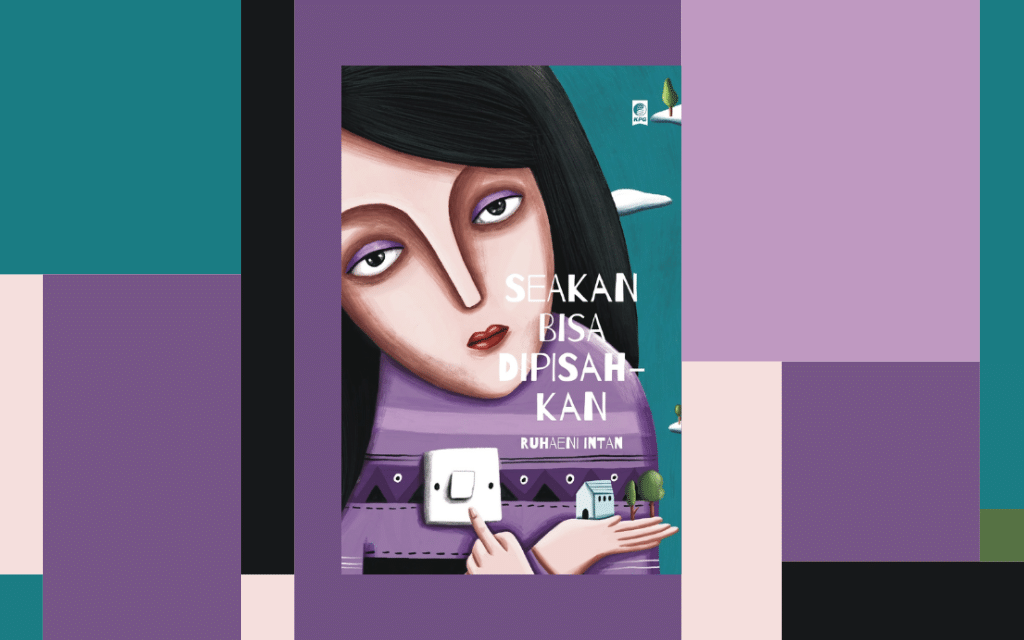
The mother-daughter relationship can be tender and beautiful, yet at the same time complicated by resentment, disappointment, and feelings that are difficult to put into words. Such complexities lie at the heart of Seakan Bisa Dipisahkan, a 117-page novella by Ruhaeni Intan. The novel was shortlisted in the Novel category of the 2026 Kusala Sastra Khatulistiwa and won second place in the fifth edition of the Hadiah Sastra Ayu Utami untuk Pemula, “Rasa”.
One a passage made me pause for a moment:
“Karena aku telah membenci Ibu, aku berhenti belajar darinya […] Tetapi siapa yang bisa menghentikan pikiran seorang anak yang diam-diam ingin meninggalkan ibunya? Tidak peduli, sekalipun pikiran itu amat berdosa.” (p. 1–2)
(“Because I had come to hate Mom, I stopped learning from her […] But who could stop the thoughts of a child who secretly wants to leave their mom? It doesn’t matter, even if such thoughts are deeply sinful.”)
The novella begins with a simple premise, yet one that feels deeply rooted in everyday life. Sofia, the eldest daughter and the story’s narrator, chooses to move away, unable to endure the conditions at home any longer. The stifling atmosphere she experiences stems from her parents’ troubled relationship—specifically, her mother’s tendency to constantly yield to her father’s irresponsible behavior. Her attempt to distance herself from her mother is challenged when her younger sister, Novia, suddenly runs away from home, following a conflict with their mother, and travels to where Sofia now lives. Through the character of Sofia and her mother, the novella explores how affection can coexist with resentment, and how the grievances they carry make it difficult for them to understand each other.
Home and the Traces of Imbalanced Relationships
One of the most compelling aspects of Seakan Bisa Dipisahkan is how Ruhaeni Intan avoids portraying the mother-daughter relationship as entirely warm or ideal. Sofia witnesses firsthand how her mother consistently defends her father although he has repeatedly been unfaithful, made unilateral decisions, and ultimately plunged their family into financial hardship.
When Sofia’s father decides to quit his job to join a multi-level marketing (MLM) scheme that yields no results, her mother is forced to shoulder the family’s financial burden. This turn of events leads her to start selling pastel (a type of savory fried pastry)—a venture that gradually becomes an integral part of their lives. Yet what pains Sofia most is not the family’s financial hardship, but her mother’s unwavering defence of her father.
Sofia captures this sentiment in a particularly poignant passage:
“Ketika banyak tetangga dan beberapa sanak saudara mulai menggunjingkan kehidupan ayahku, ibu justru setengah mati membelanya. Dia bersungguh-sungguh membelanya. Kesungguhan yang tidak bisa aku pahami, yang diam-diam merobek ikatan di antara ibu dan anak, di antara aku dan ibuku.” (p. 19)
(“When the neighbours and some of our relatives began gossiping about my father, my mother defended him fiercely. She defended him with absolute conviction. It was a conviction I could not understand, one that quietly tore apart the bond between mother and child, between my mother and me.”)
In this regard, the novella succeeds in demonstrating that Sofia’s inability to understand her mother doesn’t necessarily stem from a lack of affection. There’s a more complex dynamic at play, particularly because Sofia believes her mother had ample reason to leave the marriage, but her mother chose to stay—a decision that only widened the rift between them.
Since the story is told primarily from Sofia’s perspective, readers are given limited access to her mother’s inner thoughts and experiences. Instead, we encounter her mother through Sofia’s memories, frustrations, and interpretations, and the brief interactions they share. Even in their seemingly mundane exchanges, her mother’s coldness, sarcasm, and lack of physical affection become palpable. When Sofia finally returns home after being away for a long time and tries to convince her mother to let Novia pursue higher education outside their hometown, her mother responds dismissively, asking, “Tahu apa kamu soal masa depan?” (“What do you know about the future?”).
Nevertheless, the limited portrayal of the mother does not necessarily confine readers to Sofia’s resentment. Even though the story offers glimpses of her mother’s emotional struggles, particularly her belief that she is the only one trying to hold the family together, these experiences are still presented through Sofia’s perspective. We can sympathize with Sofia’s hurt while also recognizing that her mother has her own grievances and disappointments, even if we cannot fully understand how she experiences them. This narrative choice allows the novel to preserve the ambivalence at the heart of their relationship: understanding one another remains difficult, especially when both continue to carry their own emotional burdens.
Beyond her family issues, Sofia’s life while living away from home is shaped by her interactions with those around her, such as Pak Kaslan, a quiet neighbor who lives alone on the floor below. What begins as an unusual routine gradually becomes part of Sofia’s everyday life, as the old man often invites her to sit and drink a cup of tea with him in the afternoons. Together, they watch people return from work, their tired faces passing by below. Pak Kaslan’s presence also reminds us that Sofia is not the only one navigating her own struggles, as everyone carries experiences that may not be immediately visible to others.
Memories Wrapped in a Piece of Pastel
There’s something interesting, though implicit, that actually serves as both the starting point and the turning point in Sofia’s relationship with her mother. Unexpectedly, it’s a pastel. But how can such a simple food serve as both a bridge connecting Sofia to her mother and a wedge driving them apart?
From a young age, Sofia recalls disliking carrots, largely because her mother constantly forced her to eat them and drink carrot juice. This aversion became increasingly pronounced as her mother’s pastel business grew, making carrots an increasingly familiar yet unwelcome presence in her everyday life.
“Sewaktu aku menangis karena sudah tidak tahan lagi dengan jus wortel, ibu mendekatiku dan mengatakan kalau aku harus punya mata yang bagus supaya betah membaca buku berlama-lama. Wortel membuat mata selalu menyala ketika membaca.” (p. 18)
(“When I was crying because I couldn’t stand the carrot juice anymore, my mom came over and told me that I needed to have good eyes so I could enjoy reading books for long periods of time. Carrots keep your eyes bright and sharp while you read.”)
Sofia doesn’t necessarily interpret her mother’s insistence as an expression of concern for her eyesight alone. Rather, she connects it to her mother’s own regrets, particularly her belief that marrying Sofia’s father had prevented her from completing her education. Her mother recalls being unable to finish reading books for extended periods, which Sofia understands not simply as a matter of poor eyesight but as a reflection of her mother’s disappointment with the life she chose.
Despite her intense aversion to carrots, Sofia’s memories of the pastel are quite different. She remembers the joy she felt when her mother decided to start selling pastels. What left the deepest impression was not the taste of the pastries themselves, but the entire process she shared with her mother, including peeling carrots, shredding chicken, shelling eggs, wrapping the pastels, and tucking bird’s eye chilies into each one. Eventually, the same ingredient that Sofia associates with discomfort becomes part of an activity she remembers fondly.
These memories transform the pastel into something more than food: it becomes a reminder of a closeness Sofia once shared with her mother, when they worked side by side. At the same time, however, the pastel is also tied to a domestic environment that wasn’t always pleasant. Consequently, what began as a shared activity gradually became intertwined with memories of exhaustion, disappointment, and a relationship that grew increasingly difficult to sustain.
Because of this, the pastel becomes an inherently contradictory object in Sofia’s memories. It carries both the pleasure of having shared moments with her mother and the pain of remembering the domestic circumstances in which those moments took place. Food, however ordinary it may seem, can become deeply entangled with our emotions, allowing affection, resentment, regret, and longing to coexist within a single memory. In Sofia’s case, the pastel doesn’t simply preserve what she once shared with her mother; it also reminds her of what has since become difficult to recover.
Perhaps what makes these memories so difficult to untangle is that the relationship between Sofia and her mother can give rise to both affection and hurt, care and resentment. Neither feeling entirely erases the other, making it difficult for Sofia to look back on her relationship with her mother through just one lens. What remains is not simply a sense of nostalgia for what they once shared, but a complicated attachment to someone who has been both a source of comfort and disappointment.
On Loving and Resenting the Mother
Seakan Bisa Dipisahkan made me realize that the bond between a daughter and a mother cannot always be resolved simply by choosing to leave or to return. We may find ourselves saying that we hate our mothers because of the things they have done, or because their actions have left us feeling neglected or treated unfairly. But in Sofia’s case, does this make her an ungrateful or disobedient daughter for seeing her mother as unfair, particularly because her mother refuses to leave their father? Her resentment isn’t without reason, nor does it emerge in isolation. It’s entangled with the larger familial dynamics shaped by their father’s irresponsibility and their mother’s persistent willingness to accommodate him. At the same time, the glimpses we get of their mother’s internal turmoil, her disappointment in her children, and her conviction that she’s the only one trying to hold the family together reveal that she, too, grapples with her own emotional complexities.
In this sense, the conflict between mother and daughter cannot be understood entirely as a matter of individual choices or personal shortcomings; it is also shaped by the gendered expectations that sustain their family’s unequal relationships. As the family’s main breadwinner, the mother shoulders much of the financial burden that her husband fails to share. Yet, her efforts to accommodate him and preserve the family also have consequences for her children, particularly Sofia, who has to bear the weight of a family situation she neither created nor had the power to change. As a result, her frustration with her father’s irresponsibility becomes intertwined with her resentment toward her mother, whose decisions have directly affected her.
Their relationship is further complicated by the expectations they seem to have of one another as women within the family. The mother may have expected Sofia to understand her struggles as a wife and mother who feels she has been carrying the family on her own. Yet Sofia’s decision to leave home and remain away for a long time may have made her mother feel even more abandoned. At the same time, Sofia expects her mother to acknowledge the emotional consequences of her decisions. Both seem to seek understanding from one another, yet struggle to recognize the different burdens they carry.
What makes this novel so poignant is not merely the question of how a child should treat their mother, or how a mother should treat her child. Rather, it poses a deeper question: how do we come to understand someone who has hurt us, especially when that person is also someone we love—someone who has taken care of us since our first encounter with the world? After all, not every relationship reaches a neat resolution. Like the pastels that carry more than memories of food, Sofia’s relationship with her mother cannot be disentangled from their shared experiences, including their conflicting emotions, memories that refuse to fade, and questions that may never truly find an answer.
Nov 23, 2026 (Last modified: Nov 24, 2026)In this article Seakan Bisa Dipisahkan Ruhaeni Intan
A review of Seakan Bisa Dipisahkan, by Ruhaeni Intan (KPG, 2025)
Editor Hanifah A. Sosrokoesoemo
Laila Ramadhani is a final-year English Literature student at Universitas Brawijaya whose essays and articles have appeared in Konde.co, Critical Girlhood Studies, Anotasi, and Marginalia. Her poetry placed second at DoE VOICE 2025 (Universitas Negeri Malang) with "Behind Every Youngest Daughter," and her short story "Jatuh Mimpi" is slated for the anthology Mata Yang Menyingkap Gelap Gulita, as her focus widens from intersectional feminism toward decolonial thought. She takes on Editorial Assistant and Content Producer duties at IDWRITERS.
Latest Story
Nov 22, 2026
Nov 15, 2026
Nov 13, 2026
Nov 05, 2026
Sep 08, 2026
Call for Submissions
We welcome submissions across multiple genres including poetry, fiction, book reviews, cultural essays, and literary-focused features and opinion pieces. Please note that we only accept previously unpublished work. Accepted drafts may be edited in collaboration with our team before publication.
We’re excited to hear from writers at all stages of their craft. You can find our full submission guidelines here


Leave a Reply